Thinning: Meaning, Importance, Advantages and Disadvantages
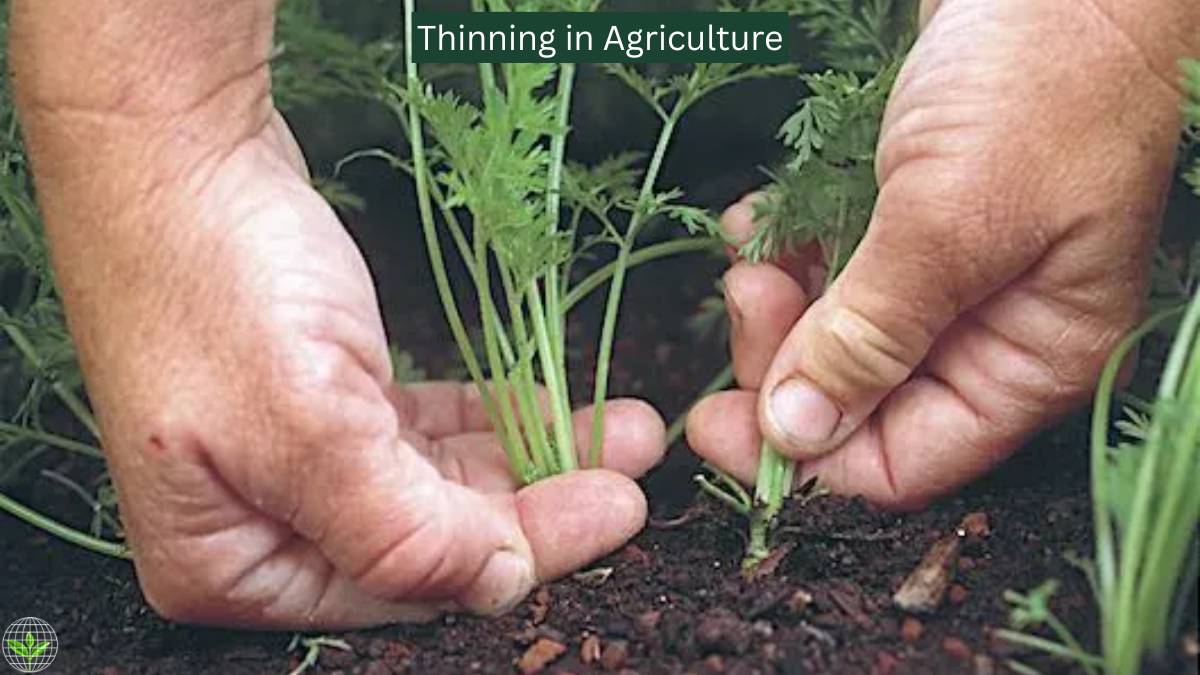
Thinning in Agriculture
In agriculture, every crop has its own seed rate, which refers to the number of seeds that have been scientifically and globally agreed to be planted per hole for a given crop. For example, the seed rate for maize is two to three seeds per hole. However, due to fear of seed failure in the field, the effects of climate change, the incidence of pests and diseases, and farmers’ inability to carry out seed testing to determine seed vigor and germination, most farmers increase the seed rates of some crops. This is done to allow all the seeds to germinate, so as to remove the weak and unhealthy seedlings to aid proper growth or avoid competition.
Therefore, the agronomic practice of gradually removing the weak and unhealthy seedlings from the plant stand to give room for the remaining seedlings to grow and develop is called thinning. Professionally, it is a post-planting operations which involve removing the weak or healthy seedlings from the population to allow the remaining seedlings to have adequate space, light, nutrients, and water for proper growth and productivity.
Thinning is one of the most difficult agronomic practices to be executed on the farm because the practice is labor-intensive, time-consuming, and energy-sapping. However, this agronomics practices help to helps to prevents overcrowding, encourage proper development, reduce competition for resources, and improve the size and quality of seed during harvest.
Thinning should be done when the seedlings are still tender, usually two to three weeks after full germination has been attained. The practice requires skills and precautions because, if not properly done, it can lead to the pulling out or destruction of the healthy plant.
Tip for Thinning in Agriculture
Thinning requires some level of skills and diligence. Without this, economics and healthy seedlings will be disturbed, leading to thinning shock, which may take a few days to cure. Some tips to observe when carrying out thinning should include the following:
- Ensure that the seed rates are overpopulated before thinning.
- Identify the weak seedling, and thin out a thins plant, and dwarfness or shortness compared to other members in the population per stand.
- Identify and remove pests and disease-infested seedlings, which include hollow leaves, damaged shoots, burning tips, and more.
- It should be executed in the morning or in the cool evening. This is to prevent a thinning shock to other plants.
- To remove the said seedling, use a hand fork to loosen the soil and detach the weak plants from the group without damaging the healthy plants.
- Where the seedlings cannot be pulled out safely, use scissors or a pruning knife to cut off the plants or the seedling close to the ground instead of pulling the seedling.
- Ensure that the remaining seedlings are gently watered immediately to reestablish the disturbed crops.
Examples of Thinning in Different Crops
- Maize and Rice: In the farmland, densely populated seedlings of maize and rice can be thinned out by removing the weak maize plants and leaving the healthiest plants to remain and grow.
- Pepper and Tomatoes: Even after being transplanted in the main field, weak seedlings of pepper and tomatoes can be removed to enable the healthiest plants to remain and grow.
- Vegetables: Vegetables such as amaranthus, water leaves, and more that are mostly sown through broadcasting can be thinned to create adequate space for the healthiest plants to develop at the correct distance apart.
- Plantation crops: In a plantation, closely packed or poorly spaced crops like oil palm (Elaeis guineensis), rubber tree (Hevea brasiliensis), and mango Mangifera indica can be selectively removed to give room for the remaining plants to grow with more space, promoting better space for adequate growth and overall quality of fruit.
- Forestry: In forests, thinning involves selectively removing some trees to give the remaining ones more growing space, promoting better diameter growth, and improving the overall quality of the timber.
Importance of Thinning in Agriculture.
The benefits of this practice in agriculture cannot be overemphasized in ensuring proper growth and productivity of crops. Some of the benefits of these practices in agriculture are enumerated by the Food and Agriculture Organization.
- Increases the yield of the crop: since the practice helps to reduce competition among plants. The available plants receive adequate care, which boosts growth and development, thereby increasing productivity. As the remaining plants have adequate space, light, water, and nutrients, better growth and development yield better quality. The practice leads to proper crop development, reduces competition for resources, and improves the size and quality of crops.
- Reduces competition: It gives space for the healthy plant to thrive by removing weak and unhealthy seedlings from the population. This ensures that seedlings have enough space and available nutrients for effective growth and productivity. When seedlings are overcrowded or overpopulated, they tend to jostle for the available resources such as water, light, and nutrients, competing with the seedlings in the hole. But the health of a thinning neighbor’s seedling or plant has enough space to access essential resources for growth and productivity.
- Improves the quality of farm produce: whenever crops compete for space, water, light, and nutrients, the seeds or fruit quality of that plant tends to be small and poorly developed. However, in a well-thinned farmland, plants have sufficient space and resources to develop seeds or fruits.
- Enhance the market value of crops: the produce from overcrowded plants tends to be small and poorly developed, while higher-quality fruits, vegetables, or roots help to increase the market value of agricultural produce, thereby increasing the farmer’s income/
- Reduce harboring of pests: overcrowded seedlings or plants serve as a home for pest infestation. When crops are spaced properly, this reduces the plant population to the required quantity, thereby creating enough space and light between neighboring plants, which helps to reduce the presence of pests.
- Enhanced plant vigor: well-thinned plants have adequate space, light, water, and nutrients for stronger and healthier growth. This enables crops to grow better and develop healthy leaves and shoots. This enables crops to resist pests and disease infestation.
Advantages of Thinning
The following are the advantages of thinning:
- It increases the yields of agricultural crops.
- It increases the quality of agricultural produce such as fruits, seeds, and roots.
- It enhances plant vigor.
- Reduce harboring of pests.
- Enhance the quality and market value of crops.
Disadvantages of Thinning
The following are the disadvantages of thinning:
- It increases the cost of production as more resources will be invested.
- It is time-consuming and energy-intensive.
- It may lead to plant shock if not properly executed.
- It may lead to pests and infestation if the remaining plant is wounded, thereby serving as a home for pests and disease infestation.
- Overcrowded crops, i.e., unthinned seedlings, lead to poor seed, fruit, and root development.
Types of Thinning in Agriculture
There are different types of crop removal in agriculture. They are classified based on the Methods of Selection or Removal.
Methods of Selection
- Low Thinning: Within a plant population per stand, some seedlings in the hole or stand may be weak, dying, or dead. Farmers may need to remove these types of seedlings to give room for the healthier plants to survive and ultimately reproduce. Hence, this method involves removing dead and dying seedlings from the population per stand to allow the healthier plants to develop into high-value crops. The advantages of this type of thinning are that it improves the vigor and growth of the healthy plants and prevents waste of resources. The disadvantage is that it is time-consuming.
- Crown Thinning: In some cases, some plants in the stand per hole may be very healthy and grow vigorously to overshadow the other. This shooter, an overgrown seedling, needs to be removed to allow uniform growth of the remaining plant. This practice is called crown thinning. It therefore involves removing the largest and most dominant seedlings in the stand, which negatively impacts the crown development of other crops. It promotes uniformity in the growth of crops in the field and aids adequate canopy formation.
- Free Thinning: This method involves selectively removing designated numbers or groups of desired seedlings from the stands to prevent competition or reduce pressure on the neighboring plants, thereby allowing them to grow and develop into healthy future crops or plants. For example, in broadcast rice farmland or an amaranthus seed bed, certain numbers of seedlings can be deliberately removed from the plant population to reduce competition, thereby allowing them to grow and develop into healthy future crops or plants. Free thinning help to healthy developed of the remaining seedlings.
- Variable Density Thinning: As the name implies, Variable density thinning involves selectively executing or carrying out thinning in some areas while deliberately avoiding thinning in other parts or portions of the farm. Variable density thinning is mostly practiced in a research farm or in a plantation. The aim of this type of thinning is to promote biodiversity and produce crops or trees with varying degrees of size.
- Diameter –Limit Thinning: This type of thinning is carried out based on the diameter of the seedlings in the farmland. In this type of thinning, the farmer removes seedlings that are above or below a certain diameter. The advantage of this type of crop removal is that it promotes uniform growth and supports effective canopy development. The disadvantage is that determining the diameter of the seedling before removing it is time-consuming.
- Ecological Thinning: This method is also called pre-commercial thinning. This involves removing seedlings that have little or no economic value, giving room for the economic seedlings to grow healthier. For example, an oil palm seedling growing in a rubber plantation is of no economic value to the farmer.
Method of Seedling Removal
- Mechanical Thinning: This method involves removing seedlings from the farm in a regular pattern. For example, sometimes, seedlings planted in a row may be poorly planted or spaced. In such a case, the farmer may need to remove the seedling completely, irrespective of its characteristics. Note: This type of types is a non-selective method that doesn’t take into consideration the health and quality of the seedlings.
- Selected Thinning: This is the opposite of mechanical thinning. Mechanical thinning doesn’t take into consideration the characteristics of the plants or seedlings before removing them. Selective thinning involves removing seedlings based on specific characteristics such as size, health status, or the position of the plant in the stand.
- Compensation Thinning: In this method, the farmers remove seedlings that are unlikely to survive naturally, thereby giving room for the healthy seedlings a better chance to thrive. It is a thinning based on natural mortality. The advantage of compensation thinning is that it prevents wastage of resources, prevents the spread of pests and disease (since a dying plant is a host to a certain disease or pest), and ensures that only the healthy plant survives. The demerit of this type of thinning is that scouting for a dying plant is time-consuming.
- Chemical Methods of Thinning: This type of thinning involves the use of agro agrochemicals that are lethal or harmful to seedlings. The chemicals are injected to remove the undesirable seedlings from the stands and create adequate space for the healthy plant to survive.