
Units of Measurement in Agriculture: Examples and Importance
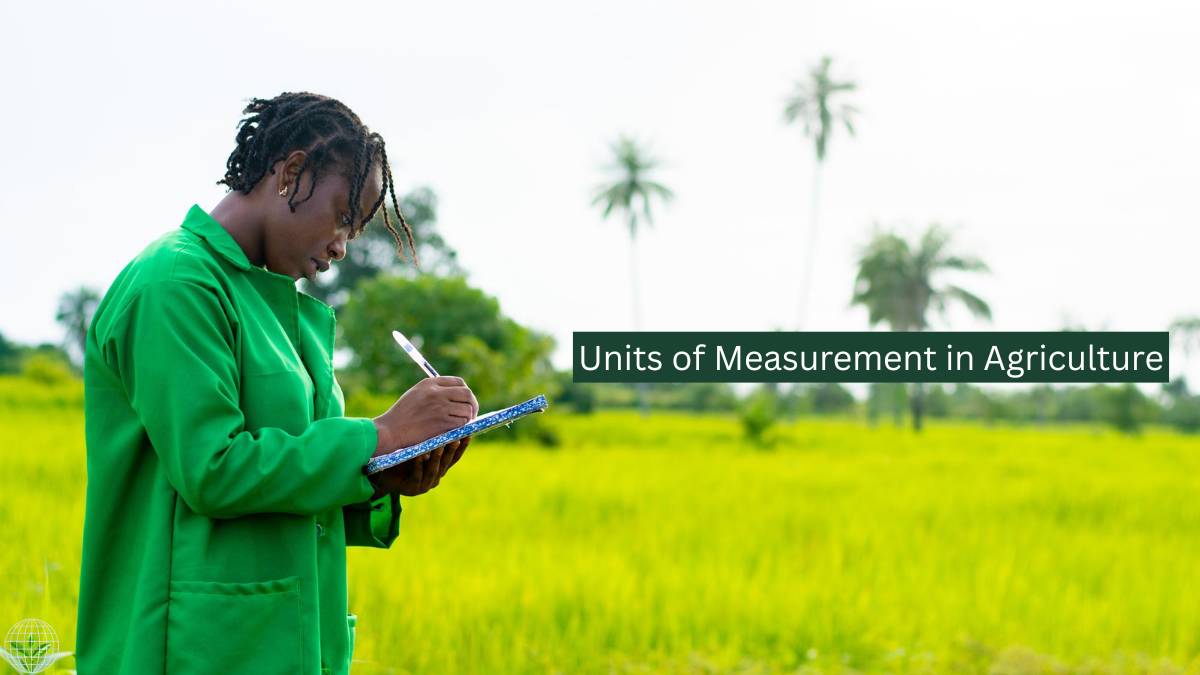
Agriculture involves measuring almost everything, from the size of farmland to the quantity of seeds required for planting. Farmers also measure rainfall, soil moisture, fertilizer application rates, crop yields, livestock weight, and the volume of water used for irrigation.
Accurate measurement helps farmers plan their activities, manage resources, monitor production, and make informed decisions. Without reliable measurements, it becomes difficult to determine how much fertilizer to apply, how many seedlings to plant, or how much produce to sell.
Units of measurement in agriculture provide standard ways of expressing these quantities. They help farmers, agricultural researchers, extension workers, processors, and traders communicate clearly and carry out farming operations more efficiently.
This article explains the meaning of units of measurement in agriculture, their importance, common examples, measuring instruments, conversion methods, and practical applications in farming.
What Are Units of Measurement?
A unit of measurement is a standard quantity used to express the magnitude of a physical quantity. It provides a common reference for measuring and comparing things such as length, mass, time, temperature, area, and volume.
For example, the metre is a standard unit for measuring length, while the kilogram is used to measure mass. The litre is commonly used to express the volume of liquids, and degrees Celsius are used to measure temperature.
A unit of measurement is different from a measuring instrument. A measuring instrument is a device used to obtain a measurement, while a unit is the standard in which the result is expressed.
For instance, a farmer may use a measuring tape to determine the length of a farm plot. The tape is the measuring instrument, while metres are the units used to express the result.
Agriculture relies on different units of measurement because farming activities involve several physical quantities. Measuring farmland requires units of length and area, while measuring harvested crops requires units of mass.
Similarly, farmers use units of volume to measure irrigation water, units of temperature to monitor storage conditions, and units of time to plan planting, harvesting, and other farm operations.
Knowledge of agricultural mathematics and measurement is therefore important for anyone involved in farming, agricultural education, processing, or marketing.
Importance of Units of Measurement in Agriculture
The importance of units of measurement in agriculture goes beyond recording quantities. Accurate measurement supports efficient production, fair trading, resource management, and informed decision-making.
The following are some of the major benefits of using standard units of measurement in agricultural activities.
1. Accurate Application of Fertilizers and Agrochemicals
Farmers need to apply fertilizers, pesticides, and other agricultural inputs at appropriate rates to achieve good results.
For example, fertilizer recommendations may be expressed in kilograms per hectare. A farmer must know the size of the farm and the recommended application rate to calculate the required quantity of fertilizer.
Using the correct units helps prevent underapplication, overapplication, and unnecessary waste. It also supports responsible handling of agricultural chemicals.
2. Proper Land Measurement and Farm Planning
Land measurement helps farmers determine the size of their farmland and plan how to use it.
Units such as metres, hectares, and square metres are used to measure farm boundaries, calculate field areas, and estimate the space available for cultivation.
Accurate land measurement also helps farmers determine planting distances, prepare farm layouts, and estimate the quantity of seeds or other inputs required.
3. Fairness in Agricultural Transactions
Standard units help buyers and sellers agree on the quantity of agricultural products being exchanged.
For example, a farmer selling rice by the kilogram or tonne can communicate the quantity more clearly than one relying on an undefined container or heap.
In Nigeria, local measuring containers such as mudu and paint rubber are commonly used in some agricultural markets. However, their capacity may differ depending on their size, shape, and how they are filled.
Using an agreed standard quantity or weighing the produce helps reduce misunderstandings and supports fair transactions.
4. Better Farm Management and Decision-Making
Agricultural decisions often depend on numerical information.
Farmers may compare crop yields from different fields, determine the amount of water required for irrigation, or calculate the cost of production per hectare.
Accurate measurements provide reliable information for these decisions. They also help farmers identify problems, evaluate performance, and improve their farming methods.
5. Improved Agricultural Research and Education
Agricultural researchers use standard units to record observations, conduct experiments, and compare results.
For example, a researcher may measure plant height in centimetres, crop yield in tonnes per hectare, and soil moisture as a percentage.
Using consistent units makes research findings easier to understand, reproduce, and compare across different locations and experiments.
6. Quality Control in Food Processing and Storage
Agricultural processing requires accurate measurement of raw materials, ingredients, and finished products.
Food processors may measure grain moisture content, the mass of harvested produce, or the volume of liquids used during production.
These measurements help maintain product consistency, reduce waste, and support appropriate storage and handling practices.
7. Efficient Use of Water and Other Resources
Water is an essential resource in agricultural production, particularly in irrigation.
Farmers may measure water volume in litres or cubic metres and express irrigation application in millimetres of water depth.
These measurements help farmers estimate water requirements, monitor irrigation practices, and avoid unnecessary water use.
8. Easier Comparison of Agricultural Quantities
Standard units allow farmers to compare quantities expressed in different units.
For example, converting the area of a farm from acres to hectares makes it easier to compare land sizes when agricultural recommendations or records use hectares.
Similarly, converting crop weight from kilograms to tonnes helps farmers compare harvest quantities and prepare production reports.
Also Check: 20 Farm Machinery and Equipment/ Implements, And Their Uses.
Examples of Units of Measurement in Agriculture
Units of measurement in agriculture are used to express different physical quantities. The appropriate unit depends on what is being measured and the level of precision required.
The following are the major categories of agricultural measurement and their applications.
1. Units of Length
Length is the measurement of the distance between two points. It is used to determine the dimensions of objects, the height of plants, and the distance between farm structures.
In agriculture, length measurements are useful for farm surveying, planting, irrigation installation, and construction.
Common units of length include:
- Millimetre (mm)
- Centimetre (cm)
- Metre (m)
- Kilometre (km)
- Inch (in)
- Foot (ft)
For example, a farmer may measure the distance between two rows of maize in centimetres or determine the length of a farm boundary in metres.
2. Units of Area
Area measures the size of a two-dimensional surface. In agriculture, it is particularly important for determining the size of farmland, calculating planting space, and estimating input requirements.
Common units of agricultural land area include:
- Square metre (m²)
- Square kilometre (km²)
- Hectare (ha)
- Acre (ac)
One hectare is equal to 10,000 square metres, while one acre is approximately 4,046.86 square metres.
For example, a farmer with a 2-hectare farm can use the farm area to calculate the amount of fertilizer required when a recommendation is expressed in kilograms per hectare.
3. Units of Mass
Mass refers to the amount of matter in an object. In agricultural practice, it is commonly described as weight, although weight and mass are technically different physical quantities.
Mass measurement is used to determine the quantity of harvested crops, livestock feed, fertilizer, seeds, and other farm materials.
Common units include:
- Milligram (mg)
- Gram (g)
- Kilogram (kg)
- Tonne (t)
For example, a farmer may purchase 50 kilograms of fertilizer or record a maize harvest of 2 tonnes.
4. Units of Volume
Volume measures the amount of three-dimensional space occupied by a substance or the capacity of a container.
In agriculture, volume measurements are used for irrigation water, liquid fertilizers, pesticides, animal feed ingredients, and other materials.
Common units of volume include:
- Millilitre (mL)
- Litre (L)
- Cubic metre (m³)
- Cubic centimetre (cm³)
For example, a farmer may use litres to measure water for irrigation or the volume of a liquid agricultural input.
One cubic metre is equal to 1,000 litres.
5. Units of Temperature
Temperature measures how hot or cold an object or environment is.
Agricultural temperature measurements are important in seed germination, greenhouse management, livestock housing, food storage, and the handling of perishable produce.
Common temperature units include:
- Degree Celsius (°C)
- Degree Fahrenheit (°F)
- Kelvin (K)
Degrees Celsius are widely used in agricultural practice. For example, a thermometer may be used to monitor the temperature of a greenhouse or a crop storage facility.
6. Units of Time
Time measurement helps farmers plan and monitor agricultural activities.
It is used to determine planting dates, crop maturity periods, irrigation schedules, livestock feeding times, and the duration of farm operations.
Common units include seconds, minutes, hours, days, weeks, and months.
For example, a farmer may record that a crop variety matures in 90 days or schedule irrigation for a specific number of hours.
7. Units of Speed and Rate
Agricultural operations frequently involve measuring how quickly something moves or how much of a substance is applied over a period or area.
Examples include tractor speed, irrigation flow rate, and fertilizer application rate.
Common units include:
- Metres per second (m/s)
- Kilometres per hour (km/h)
- Litres per minute (L/min)
- Kilograms per hectare (kg/ha)
- Litres per hectare (L/ha)
For example, a sprayer may be calibrated to apply a specific volume of liquid per hectare. Correct measurement helps ensure that the intended application rate is achieved.
8. Units of Rainfall and Soil Moisture
Rainfall is commonly measured in millimetres, while soil moisture may be expressed as a percentage or in other units depending on the measurement method.
Rainfall measurements help farmers monitor precipitation, plan irrigation, and assess the water available for crops.
For example, a rainfall measurement of 20 mm means that the rainfall would form a water layer 20 millimetres deep on a level surface if none of the water ran off, infiltrated, or evaporated.
Soil moisture measurements help farmers determine whether crops have sufficient water for growth.
Common Agricultural Measuring Instruments and Their Uses
Measuring instruments are tools used to obtain measurements. Different instruments are designed for different agricultural purposes.
| Measuring instrument | Agricultural use |
|---|---|
| Measuring tape | Measuring farm boundaries, planting distances, and structures |
| Ruler or metre rule | Measuring short lengths and plant height |
| Weighing scale | Measuring the mass of crops, livestock feed, and fertilizers |
| Thermometer | Measuring temperature in greenhouses and storage facilities |
| Rain gauge | Measuring rainfall |
| Measuring cylinder | Measuring the volume of liquids |
| Soil moisture meter | Estimating the moisture content of soil |
| Vernier caliper | Measuring the diameter of seeds, stems, and other small objects |
| Hydrometer | Measuring the relative density of liquids, such as certain agricultural solutions |
The choice of instrument depends on the quantity being measured, the required accuracy, and the conditions under which the measurement is taken.
Measurement Systems Used in Agriculture
Measurement systems provide organized sets of units and rules for expressing physical quantities.
Two commonly encountered systems are the metric system and the Imperial system. The International System of Units (SI) is the internationally recognized modern system of measurement.
1. The Metric System
The metric system is based on units that are related through powers of ten. This makes conversions between many metric units relatively straightforward.
For example:
- 1 kilometre = 1,000 metres
- 1 metre = 100 centimetres
- 1 kilogram = 1,000 grams
- 1 litre = 1,000 millilitres
Metric units are widely used in agricultural education, research, production, and trade.
2. The Imperial System
The Imperial system is a traditional system of measurement that uses units such as inches, feet, yards, miles, pounds, and gallons.
Some agricultural equipment specifications, older records, and international publications may use Imperial units.
For example, a farm measurement may be expressed in acres, while a crop production recommendation may use hectares.
It is important to know how to convert between the systems when comparing agricultural information.
3. The International System of Units (SI)
The International System of Units, commonly called SI, is the internationally recognized standard system of measurement.
It provides a consistent framework for expressing physical quantities in science, technology, and many areas of agriculture.
The seven SI base units are:
| Physical quantity | SI base unit | Symbol |
|---|---|---|
| Length | Metre | m |
| Mass | Kilogram | kg |
| Time | Second | s |
| Electric current | Ampere | A |
| Thermodynamic temperature | Kelvin | K |
| Amount of substance | Mole | mol |
| Luminous intensity | Candela | cd |
Agricultural measurements may also use derived SI units, such as square metres for area, cubic metres for volume, and metres per second for speed.
The SI system helps agricultural professionals communicate measurements consistently, particularly in research, technical reports, and international trade.
Common Agricultural Measurement Conversions
Agricultural measurement conversions allow farmers to express the same quantity in different units without changing its actual value.
Conversions are particularly useful when working with farm sizes, crop yields, fertilizers, water, and agricultural machinery.
The following table contains some common conversions.
| Measurement | Conversion |
|---|---|
| 1 kilometre | 1,000 metres |
| 1 metre | 100 centimetres |
| 1 hectare | 10,000 square metres |
| 1 hectare | Approximately 2.471 acres |
| 1 acre | Approximately 4,046.86 square metres |
| 1 kilogram | 1,000 grams |
| 1 tonne | 1,000 kilograms |
| 1 litre | 1,000 millilitres |
| 1 cubic metre | 1,000 litres |
| 1 kilogram | Approximately 2.205 pounds |
These conversions are useful when farmers receive recommendations, purchase agricultural inputs, or compare measurements recorded using different units.
Example 1: Converting Acres to Hectares
Suppose a farmer owns a farm measuring 5 acres and wants to express the land area in hectares.
Since 1 acre is approximately 0.404686 hectares:
5 × 0.404686 = 2.02343 hectares.
Therefore, 5 acres is approximately 2.02 hectares.
Example 2: Calculating Fertilizer Requirements
Suppose a farmer has a 2-hectare farm and the recommended fertilizer application rate is 200 kilograms per hectare.
The total fertilizer requirement is:
2 hectares × 200 kg/ha = 400 kg.
The farmer will require 400 kilograms of fertilizer for the entire farm, assuming the same application rate applies throughout the field.
Example 3: Converting Crop Yield to Tonnes
Suppose a farmer harvests 3,500 kilograms of maize.
To convert kilograms to tonnes:
3,500 ÷ 1,000 = 3.5 tonnes.
The total harvest is therefore 3.5 tonnes.
Example 4: Calculating Water Requirements
Suppose a farmer wants to apply 25 millimetres of irrigation water over a field measuring 1 hectare.
One millimetre of water over one hectare is equal to 10 cubic metres.
Therefore:
25 × 10 = 250 cubic metres.
The field requires 250 cubic metres of water, equivalent to 250,000 litres, before accounting for losses and irrigation efficiency.
Local Units of Measurement in Nigerian Agriculture
Although standard measurement units are widely used in agriculture, some Nigerian farmers and traders also use traditional or locally familiar measuring containers.
Examples include mudu, paint rubber, baskets, sacks, and other containers used to measure grains, legumes, and other agricultural produce.
These local units can be convenient for buying, selling, and distributing agricultural products. However, they do not always represent a fixed quantity.
For example, the capacity of a mudu may differ from one location to another. The amount of grain contained in a paint rubber may also depend on its size, the type of produce, and how the container is filled.
This means that a local container should not automatically be treated as equivalent to a particular number of kilograms or litres.
Where accurate measurement is required, farmers and traders should determine the actual capacity or mass of the container being used. A calibrated weighing scale or measuring vessel can help establish the quantity.
Standard units are particularly important when preparing agricultural records, comparing prices, calculating input requirements, or conducting research.
Common Mistakes in Agricultural Measurement
Measurement errors can lead to financial losses, poor farm management, and inaccurate agricultural records.
Farmers and other agricultural stakeholders should avoid the following mistakes.
1. Confusing Measuring Instruments with Units
A weighing scale is an instrument, while kilograms and tonnes are units of mass.
Similarly, a measuring tape is an instrument, while metres and centimetres are units of length.
Understanding this distinction helps farmers record measurements correctly.
2. Using the Wrong Unit for a Quantity
Different physical quantities require different units.
For example, farm area should be expressed in square metres, hectares, or acres, rather than kilograms. Crop mass should be expressed in kilograms or tonnes rather than hectares.
Using the correct unit prevents confusion and improves the reliability of agricultural records.
3. Converting Units Incorrectly
Errors in unit conversion can affect fertilizer application, crop yield calculations, and irrigation planning.
Farmers should use correct conversion factors and check their calculations before applying them to actual farm operations.
4. Relying on Unstandardized Containers
Containers used for local agricultural trading may differ in size and capacity.
Assuming that every container represents the same quantity can lead to disagreements and inaccurate records.
Using calibrated measuring instruments helps establish a more reliable quantity.
5. Ignoring Instrument Accuracy
Measuring instruments may become damaged, worn, or inaccurate over time.
Farmers should use appropriate instruments, check their condition, and calibrate them when necessary.
For example, a weighing scale that does not measure correctly may cause errors in fertilizer application or the sale of agricultural produce.
Conclusion
Units of measurement in agriculture are essential for accurate farming operations, effective resource management, and reliable agricultural communication.
They help farmers measure land, determine input requirements, monitor crop growth, manage irrigation, assess production, and carry out fair transactions.
Understanding the difference between measurement units, instruments, and systems also helps prevent errors and improves the quality of agricultural records.
Whether a farmer is measuring a small garden, managing a commercial farm, or selling agricultural produce in a local market, the use of appropriate and consistent measurement units supports better planning and more informed decisions.
As agricultural practices continue to improve through technology and scientific research, accurate measurement will remain an important foundation for productive, efficient, and sustainable farming.