
Livelihoods in Agriculture: Definition, Types, Example
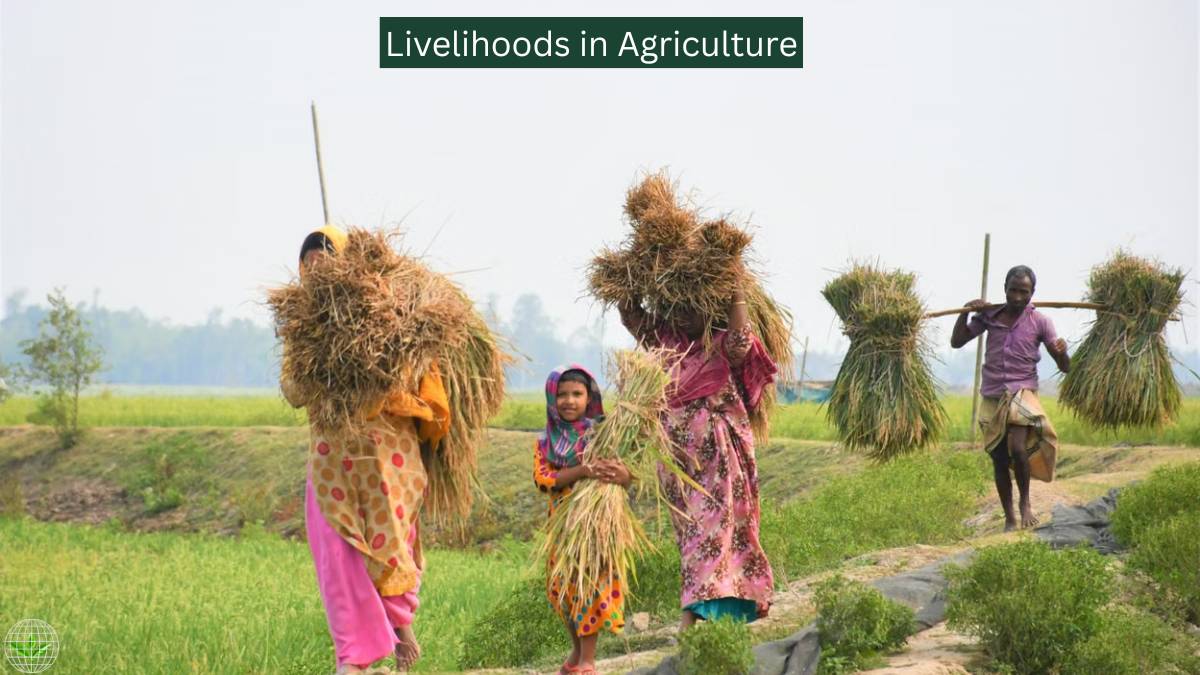
What are Livelihoods in Agriculture?
Agriculture remains one of the major sources of food, employment, and shelter for billions of people who depend on it as their major means of livelihood. From time immemorial, agriculture has not only been the main source of food and shelter, but also a significant source of foreign exchange and economic development.
Livelihood in Agriculture refers to the resources, activities, and means of sustenance that farmers engage in or use to generate income and live meaningful and economically stable lives. It also refers to the assets (such as natural assets, capital, or the combination of other assets) farmers use to create survival opportunities and improve their living conditions.
Farmers engage in different agricultural activities such as arable crop farming, wage labor, small-scale agribusinesses, feed processing, agro-industry work, farmstead building technology, pastoralism, fish farming, horticulture, forestry Services, transport, rent of farm tools/implements, or a combination of these activities and more to generate income for meaningful and economically stable lives.
Many Farmers also make maximum use of the large expanse of land available in rural areas for the cultivation of permanent crops such as rubber, mango, citrus, cocoa, oil palm, and more. These crops have a long life span, usually between 60 – 99 years. Providing a sustainable source of income or livelihood opportunities for farmers to profit is often reinvested in other areas of livelihood, such as potable water, electricity, good medical care, and seeking better education for farmers’ children.
Agriculture has significantly contributed to sustainable livelihood not only for the present farmers but also for the future ones while offering significant benefits for both local and global economic growth and sustainability in the short and long term.
Explanation of Basic Terms Used in the Above Definition
- Resources: these are natural or capital resources which farmers use to generate a means of sustenance. Land and water support activities such as crop farming, pastoralism, fish farming, and more. For example, those who engage in the cultivation of the land or rear animals, making use of the land to generate a means of survival, and those who engage in fishing using the river to generate a means of survival. Many people generate their means of livelihood from the cultivation and sale of crops such as cassava, yams, rice, and cowpea, as well as harvesting and sale of aquatic animals such as fish, snails, periwinkles, crayfish, and more.
- Activities: these are occupations or jobs that farmers engage in, so as to generate income and improve well-being. Examples include wage labor, small-scale agribusinesses, feed processing, agro-industry, pastoralism, fish farming, horticulture, forestry, and more.
- Assess: these are resources, capital, or other wealth possessed by farmers and used in the creation of further income, such as farmland, farm machines, livestock, savings, and infrastructure.
Agriculture as a Source of Food and Income
Agriculture remains one of the major sources of food and income for both small and large-scale farmers in the agricultural sector. For billions of individuals across the globe, access to crops and livestock determines food security and income stability. Farmers engage in agricultural activities such as crop cultivation, livestock rearing, food processing, marketing, and wage labour to earn a living.
These agricultural activities provide food for billions of the world’s population and also serve as a source of income, as it is often said that a country that cannot feed itself will go bankrupt. So, agriculture remains a source of food for the world’s population.
Agriculture also provides a major source of minerals for the growth and development of man and animals. Mineral nutrients such as calcium, potassium, phosphorus, iron, and more are needed for the normal functioning of the body system. Agricultural produce is also required in the agro-allied industries for the production and processing into finished and semi-finished products.
These products are either sold or exported to other countries, which serve as a source of income to small, medium, and large-scale farmers. Small-scale farmers are often engaged in on-farm and off-farm activities, which serve as an additional source of wages or salaries along with their farm. In the developing countries, some of these farmers work in other commercial farm and the wages are reinvested into enlarging their own personal farm contribute almost similar proportion to farmer livelihoods. This increases access to food and income through farming, which helps to build internal resilience and thereby helping farmers to take up other opportunities.
Example of livelihood in Agriculture
The types of livelihood in agriculture, as submitted by the Food and Agriculture Organization, are: Agricultural labour, non-agricultural labour, agri-business, service, transport, rent of implement/tool/warehouse, agro-processing industry, crafting, and feed processing.
- Farming Activities: farmers engage in crop production, livestock rearing, forestry, horticulture, floriculture, and more to generate income to improve household well-being by providing security, resilience, capability, and equity for sustainability. Food products or profit obtained from the sales of these farming activities will enable farmers to meet their fundamental household needs, such as food, shelter, education, and healthcare, while simultaneously building resilience against financial and food insecurity.
- Agricultural Wage Labour: Agriculture is one of the economic sectors that provide employment opportunities for semi-skilled, skilled, and unskilled labour through direct employment in the maintenance and management of crops, livestock rearing, forestry, horticulture, floriculture, and more, to generate income to improve households. The income generated can be used for providing food or enable farmers to meet their fundamental household needs. Skilled workers are employed in the agricultural sector as agricultural teachers, extension workers, and in other agro-based industries. Earning monthly salaries as a means of livelihood.
- Non-agricultural Labour: Beyond crop production, agribusiness, food processing, and related agro-allied trade activities. Individuals earn wages and salaries from agro-allied trade industries, which serve as a sustainable means of livelihood to improve their well-being. Non -agriculture labourers, such as farmstead building technologies, electricians, plumbers and carpenters, and other workers on the farmstead earn wages which serve as food and economic stability.
- Agri-Business: Farmers are often involved in agribusiness, food processing, related agro-allied trade activities, and small-scale agro enterprises. Revenue generated from these trades is used for purchasing household items that will make life meaningful to them. The profit accrue from these businesses is something reinvested for the purchase of other commodities to enjoy economies of scale or to meet other essential needs, such as food, shelter, education, and healthcare.
- Service: Through various agriculture services such as repair and maintenance of farm machines, implement, veterinary services, and other related services provided by individual or farmers in the agricultural sector can empower them to break free from the cycle of poverty, and stimulate economic growth and stability.
- Transport: Individuals or farmers that involved in the movement of agricultural commodities from one place to another or from one countries to another drive suitable means of livelihood from such service, through creating change in their economic well-being and providing income opportunity and enabling them to become family breadwinner.
- Rent: Through the rent of farming tools such as spades or shovel, wheel barrow, knapsack sprayer, and other farm machine like tractors, and its implement, bulldozer, incubator, and more can serve as mean s of sustenance to individual farmers that involved in these types of services.
- Agro-allied Industry: Farmers who build agro-processing industries that convert raw materials into finished or semi-finished agricultural products derive means of sustenance from these industries. They also serve as a means of employment opportunities for other individuals who engage in activities in the industries.
- Crafting: Certain skills are possessed by farmers which are used in fabricating or manufacturing some simple tools and implements for performing one activity or the other in the farm. The sales of these locally fabricated tools and implements by farmers or their children can generate a reasonable source of income for their sustenance.
Components of Livelihood in Agriculture
There are many means of Livelihood in Agriculture, ranging from natural gifts, skills, and wealth used in the creation of further wealth. These means of livelihood are categorized into five components that can influence a person’s ability to generate livelihood opportunities in agriculture.
- Human Resource: These are resources or abilities that exist within farmers or individuals which enable them to generate means of livelihood. Examples of these human resources are skills, knowledge, and health. These resources exist within human ability to create a sustainable source of income for meaningful living.
- Physical Resource: These are assets possessed by the farmers which serve as a means of livelihood. These assets include tools and implements, such as spades, cutlasses, and tractors and their implements. Basic infrastructure such as animal facilities and farmstead, transport facilities, and farm resources such as crops and animals at the farmers’ disposal.
- Natural Resources: These are God-given gifts which the farmers use to generate sustainable means of livelihood. These God-given resources are Land, water, and resources that are located in them. For example, man cultivates crops and rear animals such as cowpea, cassava, yam, and animals such as goat, sheep, and cattle on the land, which are harvested for food. Man also rear aquatic animals such as fish, crab, crayfish, and crocodile, which generate a means of livelihood.
- Financial Capital: These are resources accrued from the sales of farm outputs and services provided by the farmers. These resources can be the money at hand, money in the banks (savings), assets owned (such as tractors, farm buildings, crops, and animals), and other financial resources.
- Social Resources: nobody lives in isolation. Interpersonal relations exist between the farmers and the people around the farmers’ communities. These relationships between the farmers and the people within the community can create enabling opportunities for a means of livelihood. These social networks include relationships and collaboration with the members of the communities.
Diversification of Agricultural Livelihoods
As the saying goes, “No man should put all their eggs in one basket or bucket,” justify livelihood diversification. Livelihood diversification, therefore, is the process of considering or investing in more than one means of livelihood activities at a time to serve as insurance against unforeseen circumstances or decrease dependency on a single major livelihood activity or for a better source of livelihoods. Since human wants are usually unlimited and Farmers or individuals have limited resources to satisfy these wants due to scarce resources, humans often devise other sources of income or means of sustenance because of uncertainty in life. Considering more than one means of livelihood activity at a time is not completely out of place. These can serve as insurance against uncertainty, reduce over-dependency on a single major livelihood activity, and provide more income or financial security.
Diversification of agricultural livelihoods can take any of these forms: a crop farmer involved in the rearing of intensive rearing of poultry birds for egg and meat source, or a farmer who is into large production of cattle invests in large-scale oil palm production, or a farmer into oil palm production later invests in processing palm oil or other oil palm processing industries.
Diversification of Agricultural Livelihoods can be horizontal diversification or vertical diversification.
Vertical diversification
This is when a farmers or individual seek another means of livelihood related to farming or within a means of livelihood. For instance, a farmers who is into cassava production diversify into cassava flour processing industries, or from yam production into yam production industries.
Horizontal diversification
This is when a farmers or individual seek another means of livelihood different from the former or different means of livelihood. For instance, a farmers who is into cassava production diversify into agro-business or animal production.
Diversification can be done through mixed farming and mixed cropping.
- Mixed farming is the process whereby a farmer cultivates crops and rear animals on the same piece of land.
- Mixed cropping is the process whereby a farmer cultivates different types of crops on the same piece of land.
Both mixed cropping and mixed farming serve as a sustainable means of livelihood for the farmer.
Climate Change and Rural Livelihoods
Climate change significantly affects rural livelihoods, particularly in communities where agriculture is the primary source of income and employment. Changes in temperature, rainfall, relative humidity, sunshine, and wind patterns can disrupt agricultural activities, resulting in reduced crop yields, lower livestock productivity, and increased water stress. Inadequate irrigation facilities and limited access to climate-related information and adaptation resources make small-scale and medium-scale farmers especially vulnerable to these challenges.
The effects of climate change are evident in the increasing risks of droughts, floods, wildfires, and other extreme weather events. Many rural communities lack the technical knowledge, skills, financial resources, and infrastructure needed to prepare for these uncertainties and manage their consequences effectively. As a result, climate-related shocks can undermine agricultural production and threaten the livelihoods of farming households.
Persistent climate-related challenges have two major implications for rural livelihoods. First, they make farmers’ incomes and financial assets less secure, as crop failures, livestock losses, and damaged farm infrastructure can reduce earnings and increase production costs. Second, they limit farmers’ ability to improve their household living conditions and build more sustainable livelihoods. When agricultural income becomes unpredictable, households may struggle to meet basic needs, invest in farm improvements, or recover from unexpected losses.
These challenges also affect agribusinesses, rural employment, and local food systems. Irregular rainfall, rising temperatures, increased evaporation, and prolonged drought can reduce the number of viable cropping seasons and limit opportunities for agricultural production. Over time, repeated climate-related losses may erode farmers’ assets, weaken biodiversity, increase food insecurity, and reduce employment opportunities in rural communities.
As farming becomes more uncertain, some rural residents increasingly seek alternative sources of income outside agriculture. Agribusiness households and young people with limited access to farmland may migrate to urban areas in search of more reliable employment and better livelihood opportunities. This migration can contribute to an ageing rural population, leaving fewer young people available to participate in agricultural production and rural development.
Those who remain in rural communities may diversify their income by engaging in small businesses and other non-farm activities. These activities can include operating tea stalls, running small shops that sell household essentials, hawking goods, and weaving. Such alternative livelihoods can help households supplement agricultural income, cope with climate-related risks, and meet their daily needs.
Addressing the effects of climate change on rural livelihoods therefore requires measures that strengthen farmers’ ability to adapt. Improved irrigation, access to reliable climate information, climate-resilient farming practices, better agricultural extension services, and opportunities for non-farm employment can help rural households reduce their vulnerability and build more secure, sustainable livelihoods.
Women and Youth in Agricultural Livelihoods
Women and young people play an important role in agriculture, contributing to different stages of the agricultural value chain, from production and processing to marketing and sales. Their involvement supports food production, creates employment, and provides income for many households. They take part in crop cultivation, livestock rearing, agro-processing, and other agricultural businesses as a way of earning a living and supporting their families.
In many rural communities, women and young people from low-income households also depend on farm labour for their daily needs. They carry out tasks such as land preparation, weeding, fertilizer application, pest and disease control, and harvesting. For them, these activities provide opportunities to earn income, especially when they have limited access to land, equipment, or other resources needed to run their own farms.
Women who have access to larger areas of farmland may engage in farming on a bigger scale. This can help improve their income and create more opportunities to support their households. They often adopt different farming practices and manage their available resources to meet both farm and family needs. Women also commonly maintain home gardens, where they grow a variety of crops together to provide food for their households. These gardens can improve household food availability while allowing women to develop practical farming skills and increase food production.
Young people contribute to agriculture in several ways beyond crop cultivation and livestock production. Some operate and maintain farm machinery, apply herbicides, assist with harvesting, or provide other farm-related services for income. Their participation in these activities helps them earn a living and gain experience that can support further opportunities in the agricultural sector.
When farming alone does not provide enough income, women and young people may also turn to other small businesses. These include selling vegetables, running grocery shops, operating roadside businesses and tea stalls, hawking goods, and engaging in activities such as weaving or clothing sales. Such alternative sources of income help households meet their daily expenses and reduce their dependence on farming alone. Together, agricultural work and related businesses provide important livelihood opportunities for women and young people, particularly in rural communities.